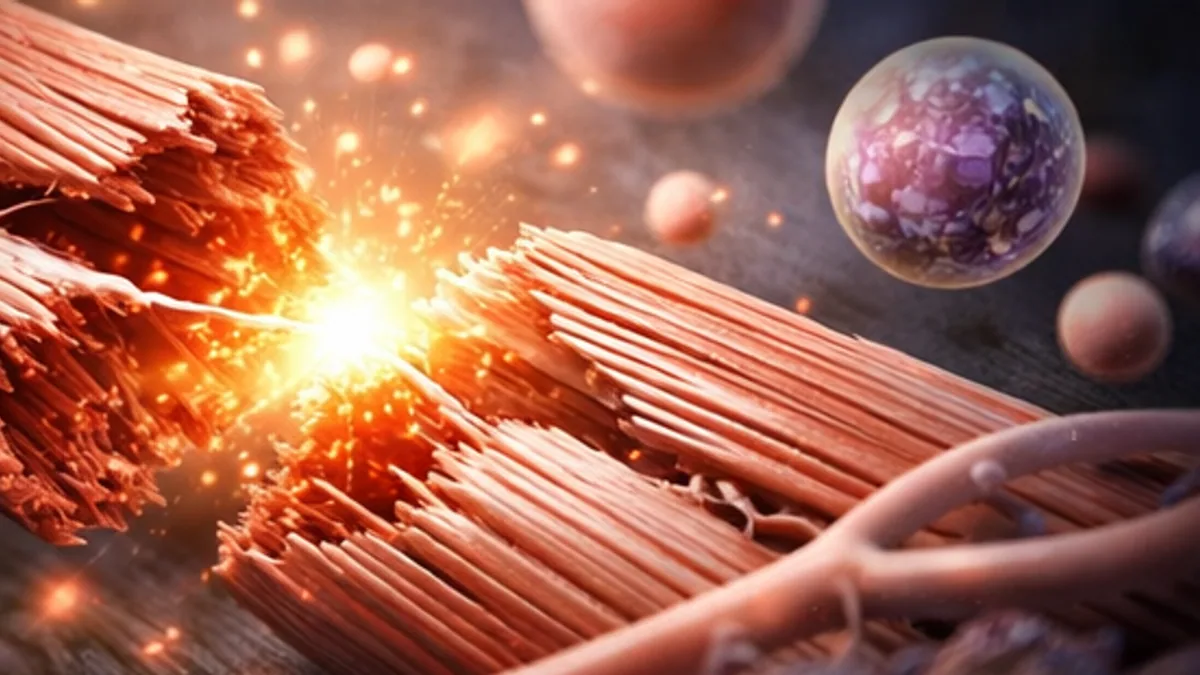
Among research peptides, BPC-157 is frequently associated with tissue repair and recovery. While its origins lie in gastrointestinal research, interest has expanded into musculoskeletal contexts, particularly muscle recovery following injury or mechanical stress . This shift has generated both legitimate scientific curiosity and exaggerated claims.
Understanding BPC-157’s role in muscle recovery requires separating what has been demonstrated in controlled research from assumptions drawn from anecdotal use. The goal is not to dismiss interest, but to ground expectations in evidence.
What Is BPC-157?
BPC-157, or Body Protection Compound-157, is a synthetic peptide derived from a naturally occurring protein fragment found in gastric juice. It has been studied primarily for its cytoprotective properties—its ability to preserve tissue integrity under stress .
Unlike peptides designed to directly stimulate growth hormone or anabolic pathways, BPC-157 appears to exert its effects through indirect biological mechanisms related to vascular signaling, inflammation modulation, and cellular protection.
Proposed Mechanisms Relevant to Muscle Recovery
Research suggests several mechanisms through which BPC-157 may influence muscle repair processes. These mechanisms do not directly “build muscle” but may support conditions favorable to recovery.
1. Angiogenesis and Blood Flow Regulation
One of the most cited mechanisms involves BPC-157’s interaction with nitric oxide (NO) signaling. Studies indicate it may help normalize blood vessel function under injury conditions, potentially supporting nutrient and oxygen delivery to damaged tissue.
Improved local perfusion is a foundational requirement for tissue repair, particularly in muscle fibers recovering from strain or trauma.
2. Modulation of Inflammatory Signaling
Inflammation is a double-edged sword in muscle recovery. Acute inflammation initiates repair, but excessive or prolonged inflammation can impair regeneration.
Animal studies suggest BPC-157 may help regulate inflammatory mediators, potentially reducing secondary tissue damage without fully suppressing the inflammatory response needed for healing.
3. Cellular Migration and Structural Repair
Some studies indicate that BPC-157 may influence fibroblast activity and cellular migration, both of which play roles in repairing connective tissue interfaces where muscle fibers attach to tendons and fascia.
This may explain why BPC-157 is often discussed alongside tendon and ligament recovery rather than isolated muscle hypertrophy.
What the Evidence Actually Shows
Preclinical Muscle and Soft Tissue Studies
Most data linking BPC-157 to muscle recovery comes from animal models involving:
- Muscle transection or crush injury
- Tendon-muscle junction damage
- Immobilization-related muscle degeneration
In these models, BPC-157 has been associated with:
- Faster structural reorganization
- Improved functional outcomes compared to untreated controls
- Reduced fibrosis in healing tissue
However, these findings occur under controlled experimental conditions that do not directly replicate athletic training or human injury patterns.
Absence of Robust Human Clinical Trials
At present, there are no large-scale, randomized human trials specifically evaluating BPC-157 for muscle recovery. This absence is critical. While animal data is promising, it cannot establish efficacy or safety in humans.
Any extrapolation beyond preclinical evidence remains speculative.
Common Misconceptions About BPC-157 and Muscle Recovery
Misconception 1: “BPC-157 Builds Muscle”
BPC-157 is not anabolic. It does not stimulate muscle protein synthesis in the way growth hormone peptides or anabolic agents do. Any perceived improvement in muscle condition is more accurately attributed to enhanced recovery capacity, not direct hypertrophy.
Misconception 2: “It Works Like Growth Hormone”
Unlike GH-related peptides, BPC-157 does not significantly influence IGF-1 or systemic growth pathways. Its effects appear localized and supportive rather than systemically anabolic.
Misconception 3: “Animal Results Equal Human Outcomes”
Rodent muscle regeneration occurs far more rapidly than in humans and under different physiological constraints. Animal success does not guarantee human effectiveness.
Where BPC-157 Fits in Muscle Recovery Research
BPC-157 is best understood as a supportive recovery-context peptide , not a performance enhancer. Its potential relevance lies in:
- Injury recovery models
- Soft tissue integrity maintenance
- Reducing secondary tissue damage
It does not replace training adaptation, nutrition, or rest, nor does it override biological limits.
Comparison With Other Recovery-Related Peptides
| Peptide | Primary Research Focus | Muscle Recovery Role |
|---|---|---|
| BPC-157 | Cytoprotection, angiogenesis | Indirect, supportive |
| TB-500 | Actin regulation | Structural repair emphasis |
| Hexarelin | GH release | Systemic recovery signaling |
This distinction helps contextualize claims and avoid misapplication.
Safety and Research Context Considerations
BPC-157 is not FDA-approved and is classified as a research compound. Long-term safety, dosing standards, and interaction profiles remain undefined in humans.
Responsible interpretation requires acknowledging these limitations and avoiding claims unsupported by clinical evidence.
Final Takeaway
BPC-157 ’s association with muscle recovery is rooted in preclinical research suggesting improved tissue repair environments rather than direct muscle growth. Its mechanisms appear supportive—enhancing vascular signaling, modulating inflammation, and aiding structural repair processes.
While the data is intriguing, it remains incomplete. BPC-157 should be discussed within the context of experimental research, not as a proven recovery solution.
References
- McGuire FP, Martinez R, Lenz A, Skinner L. Regeneration or Risk? A Narrative Review of BPC-157 for Musculoskeletal Healing. https://pmc.ncbi.nlm.nih.gov/articles/PMC12446177/
- Sikiric P, et al. Stable gastric pentadecapeptide BPC 157 as therapy after muscle-to-bone detachment in rats. https://pmc.ncbi.nlm.nih.gov/articles/PMC11768438/
- Vukojevic J, et al. Pentadecapeptide BPC 157 and the central nervous system. https://pmc.ncbi.nlm.nih.gov/articles/PMC8504390/
- Sikiric P, et al. Stable gastric pentadecapeptide BPC 157 and striated, smooth, and heart muscle. https://pmc.ncbi.nlm.nih.gov/articles/PMC9775659/
- Kresovic D, et al. Emerging Use of BPC-157 in Orthopaedic Sports Medicine: A Systematic Review. https://pmc.ncbi.nlm.nih.gov/articles/PMC12313605/
- McGuire FP, et al. BPC-157 shows strong preclinical effects but minimal human trials and remains investigational. https://pmc.ncbi.nlm.nih.gov/articles/PMC12446177/
- Systematic findings: BPC-157 promotes angiogenesis, fibroblast activity, and muscle regeneration pathways in animal models. https://pmc.ncbi.nlm.nih.gov/articles/PMC12446177/