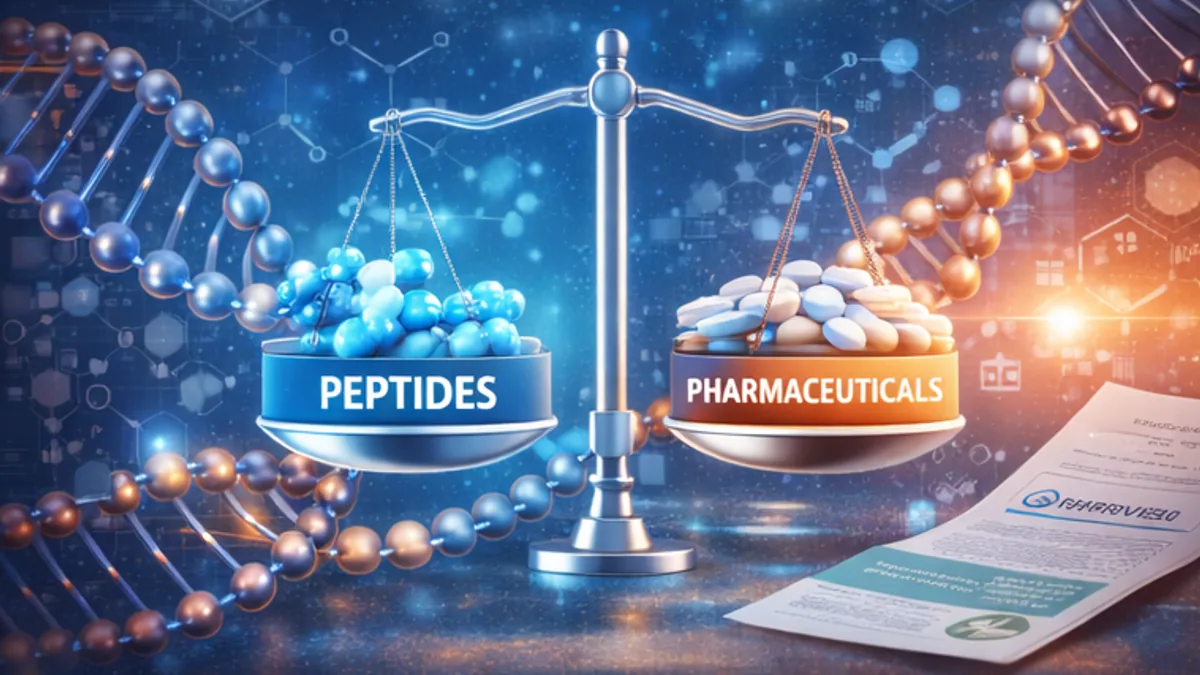
Peptides are often casually grouped together with traditional drugs, but scientifically speaking, they belong to a fundamentally different class of compounds.
Understanding how peptides differ from conventional pharmaceuticals requires looking beneath surface-level outcomes and into molecular structure, biological signaling, regulatory pathways, and safety dynamics.
These differences shape not only how peptides work — but how they’re studied, regulated, and applied.
Structural Differences: Biological Messengers vs Chemical Modulators
Traditional pharmaceuticals are typically small-molecule compounds created through chemical synthesis. Their structures are compact, allowing them to pass easily through cell membranes and interact broadly with enzymes or receptors.
Peptides, by contrast, are short chains of amino acids — essentially miniature proteins. This structural distinction leads to major functional consequences. Small-molecule drugs often act by:
- Blocking enzymes
- Inhibiting receptors
- Altering neurotransmitter levels
- Suppressing inflammatory cascades
Peptides usually function by:
- Mimicking endogenous signaling molecules
- Activating specific receptors
- Triggering intracellular pathways
- Supporting regenerative or regulatory processes
Rather than forcing biological outcomes, peptides more often signal the body to respond . This makes peptides closer to physiological messengers than chemical overrides.
Mechanism of Action: Targeted Signaling vs Broad Intervention
Most pharmaceuticals are designed to suppress or stimulate biological systems directly.
Blood pressure medications reduce vascular tone. Statins inhibit cholesterol synthesis. SSRIs alter neurotransmitter reuptake.
Peptides generally operate upstream. They bind to naturally existing receptors and initiate signaling cascades already present in human biology. This results in:
- More targeted pathway engagement
- Less off-target binding (in many cases)
- Reduced systemic disruption
For example, growth hormone–related peptides stimulate the pituitary to release endogenous GH rather than introducing synthetic hormone directly.
This distinction is subtle but critical.
Pharmaceuticals often replace or block function. Peptides usually encourage existing function.
Pharmacokinetics: Half-Life and Metabolism
Traditional drugs frequently have long half-lives and are metabolized through hepatic pathways, producing active metabolites that can persist in circulation.
Peptides behave very differently. Most are:
- Rapidly broken down by proteolytic enzymes
- Cleared quickly from plasma
- Converted into natural amino acids
This short biological lifespan means peptides rarely accumulate in tissues. However, it also means they typically require:
- Injectable delivery
- Specialized formulations
- Repeated dosing
Oral bioavailability remains a major limitation for most peptide compounds.
Safety Profiles: Predictability vs Biological Variability
Conventional pharmaceuticals undergo extensive human trials before approval. Their adverse event profiles are well characterized. Peptides exist on a broader spectrum.
FDA-Approved Peptides
These have established safety data similar to other drugs.
Research Peptides
These often rely on Animal Models , Cell Culture Studies and Limited Human Data .
Because peptides engage native signaling pathways, they may appear “gentler,” but this does not eliminate risk. Potential concerns include:
- Immune sensitization
- Receptor desensitization
- Hormonal feedback disruption
- Unknown long-term effects
Importantly, peptides may feel safer acutely while still carrying uncertain chronic risks.
Delivery Differences: Pills vs Precision Administration
Most pharmaceuticals are taken orally. Peptides almost never are.
Digestive enzymes rapidly destroy peptide chains, making oral delivery ineffective without advanced formulation technologies. As a result, peptides are commonly administered via:
- Subcutaneous injection
- Intramuscular injection
- Intranasal routes (select compounds)
This introduces practical considerations such as sterility, dosing accuracy, and tissue tolerance that do not apply to tablets or capsules.
Regulatory Pathways: Established Pipelines vs Experimental Space
Traditional pharmaceuticals follow rigid development pipelines:
- Preclinical testing
- Phase I safety trials
- Phase II efficacy studies
- Phase III large-scale validation
- Regulatory approval
Many peptides follow the same path. But research peptides occupy a parallel universe. They are:
- Legal for laboratory research
- Not approved for human use
- Not manufactured under pharmaceutical GMP standards
- Largely unregulated for purity or consistency
This regulatory divide creates enormous variability in quality and safety depending on source.
Comparing Peptides and Traditional Drugs at a Glance
| Feature | Peptides | Traditional Pharmaceuticals |
|---|---|---|
| Structure | Amino acid chains | Small chemical molecules |
| Action | Receptor signaling | Enzyme inhibition / modulation |
| Targeting | Often highly specific | Frequently broader |
| Half-life | Short | Longer |
| Accumulation | Minimal | Possible |
| Delivery | Injectable / specialized | Usually oral |
| Regulation | Mixed (approved + research) | Strictly regulated |
| Long-term data | Limited for research peptides | Extensive |
Practical Implications for Research and Medicine
Neither category is inherently superior. Each serves different purposes.
Pharmaceuticals excel in:
- Acute disease management
- Chronic condition control
- Standardized dosing
Peptides excel in:
- Studying biological signaling
- Exploring regeneration pathways
- Investigating metabolic regulation
Increasingly, modern medicine integrates both approaches. Many next-generation therapies now combine small molecules with peptide-based biologics to achieve precision while maintaining systemic control.
The Bottom Line
Peptides are not simply “natural drugs.” They represent a fundamentally different pharmacological philosophy — one rooted in signaling rather than suppression.
Traditional pharmaceuticals impose outcomes. Peptides attempt to guide them.
That distinction explains both the excitement surrounding peptide research and the caution urged by scientists.
Peptides hold extraordinary promise — but they demand scientific rigor, regulatory respect, and realistic expectations.
References
- Fosgerau K, Hoffmann T. Peptide therapeutics: current status and future directions. Drug Discovery Today. https://pubmed.ncbi.nlm.nih.gov/24495449/
- Lau JL, Dunn MK. Therapeutic peptides: historical perspectives, current development trends, and future directions. Bioorganic & Medicinal Chemistry. https://pubmed.ncbi.nlm.nih.gov/26869409/
- Craik DJ et al. The future of peptide-based drugs. Chemical Biology & Drug Design. https://pubmed.ncbi.nlm.nih.gov/26073639/